
The Florida Bar CLE: How to Create a Course and Get Approved
To create a CLE course for The Florida Bar, you work with a sponsor, usually a section of The Florida Bar or an approved CLE provider. You bring a topic lawyers need, a timed outline, materials and qualified speakers. The sponsor submits it to The Florida Bar for accreditation, and once it's approved, you share it.
Why I wrote this
I'm Blake Hickey. I'm a marketer, not a lawyer. I've been in marketing since 2006. In 2024, I moderated and helped produce Navigating Lawyer Advertising Compliance: Foundations of Legal Advertising, a CLE program with The Florida Bar Business Law Section. I've also helped produce continuing education for accountants and a podcast for an orthodontic practice, worked behind the camera on Walmart commercial shoots, and spent plenty of time in front of the camera myself.
When I help lawyers with a CLE, I hear the same questions over and over. If you've done one with me, you've probably seen the guides I hand out. Some people laugh and tell me, "I don't need a book. Just tell me how to do it." Fair enough. The Florida Bar publishes a lot of good information, but it's spread across policies, FAQs and forms you have to click through. So this is the summary, with links to The Florida Bar's own pages so you can check every step yourself.
I'm also married to a teacher, and I teach adults all the time. We laugh about how the same rule works in every classroom. Everyone learns a little differently, so good teachers make it easy and tailor it to the room. Most of us remember a teacher like that. A good CLE should feel the same way.
I also just like this stuff. I grew up competing in BMX, wakeboarding and snowboarding, and I always wanted to get better. I don't compete like that anymore. I compete in business now, and I'd like to see the legal industry keep getting better, too. Helping more lawyers teach is one way to push that forward.
Why teach a CLE?
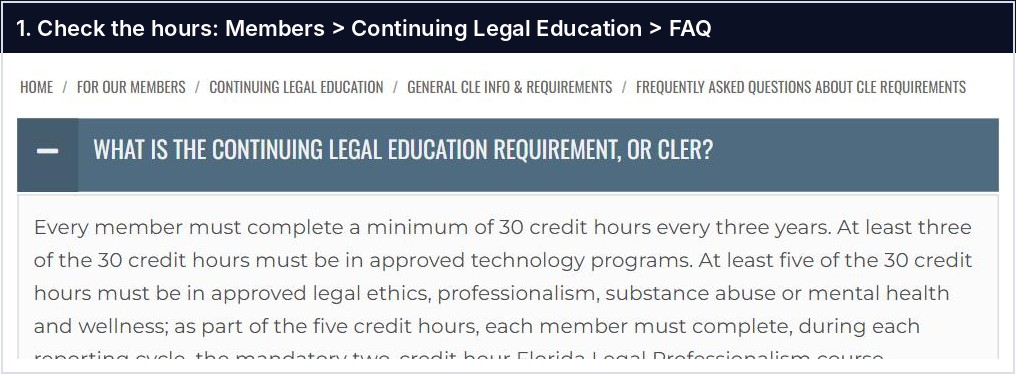
Every member of The Florida Bar needs 30 CLE hours every three years. At least 5 have to be in ethics, professionalism, substance abuse or mental health and wellness, including The Florida Bar's 2-hour professionalism course, and at least 3 in technology. So lawyers are always looking for good courses.
You don't get paid to teach a CLE, and it isn't a money-maker. Lawyers teach for other reasons:
You earn credit for it. The Florida Bar lists "lecturing at an approved CLE program" as a way to earn CLE hours.
Your peers, and the lawyers who refer you work, get to watch how you think through a real problem.
Your section gets current, useful content for its members.
It helps. The more our lawyers know, the better they serve their clients.
One recording keeps working for months as a trailer, clips and posts.
Show proof of life
I joke about this with my clients, my friends and my wife. In a horror movie, when someone gets taken, the family says, "Show proof of life." Show me they're real, and show me they're OK.
That's how I feel about AI. Anyone can ask a chatbot a question now, and anyone can have an AI avatar read a slideshow. When a lawyer gets in front of the camera and teaches what they know, people can see there's a real person there. As a non-lawyer, that's what I look for when I hire a lawyer or pick a doctor. Seeing the real person builds trust.
The timing is good, too. The guidance keeps moving. On October 15, 2026, The Florida Bar News reported that The Florida Bar's ethics committee may take up agentic AI, AI notetakers, guidance for clients and updates to Ethics Opinion 24-1. When guidance changes, lawyers look for a current course taught by someone they can see.
Work with a section or a provider
The Florida Bar accredits courses, and a sponsor submits them. For most lawyers, the sponsor is a section of The Florida Bar. Sections have CLE committees that plan their calendars, and section staff help with forms and deadlines. Each section runs its own process, so the first step is to reach out to the one that fits your topic and ask how it works.
Find the section that fits your topic on The Florida Bar's Sections and Divisions page (linked below), and look for its CLE committee.
Check the CLE course catalog to see what has already been taught.
Reach out to the section, and ask what it needs from you and how far ahead it plans. Sections plan well in advance. The Business Law Section's 2026 planning checklist, for example, aims for at least 70 days from first contact to the program date.
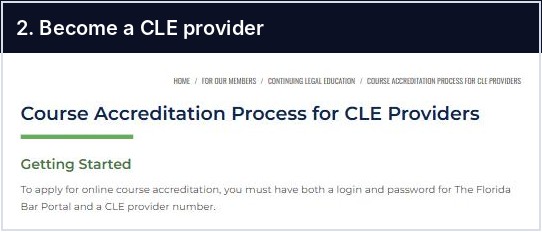
If no section fits, you can work with another approved CLE provider, or apply to become a provider yourself through The Florida Bar's course accreditation process, which needs a login for The Florida Bar’s member portal and a CLE provider number.
What does The Florida Bar look for?
The Bar's course approval policies (the 500 series of the Board of Legal Specialization and Education's policies) set the bar. Here's what they say, and what it means for you:
The Bar's policy says | So your course needs |
|---|---|
"Significant intellectual or practical content" and speakers "qualified by practical or academic experience" (5.01(a)) | Something lawyers can use, taught by people who know it |
"High quality and carefully prepared materials" for attendees (5.01(b)) | Slides or a handout people can keep |
"Fifty minutes of course time is equivalent to 1 credit hour" (5.03(b)) | At least 50 minutes of content for 1 credit (25 minutes earns 0.5) |
Recorded courses earn credit "in the same manner as for live CLE courses" (5.07(a)) | You don't have to teach it live |
No credit for content that only markets legal services, or markets a technology product (5.08(e), 5.09(f)) | To teach, not sell |
The accreditation application also asks for a detailed time schedule, a topic outline and a bio for each speaker. Your section may add its own guides. The Business Law Section gave our speakers PowerPoint guidelines and course material formatting guides, so follow your section's version first.
What gets a course approved, and what gets it turned down
Helps it get approved | Gets it turned down |
|---|---|
Practical content lawyers can use in their work | Content that only markets legal services, or only covers increasing profitability (5.08(e)) |
Speakers with real experience in the subject | A course designed mainly for people who aren't lawyers (5.08(a)) |
A timed agenda, a topic outline and bios | Marketing a technology product, if you want technology credit (5.09(f)) |
Slides or a handout people can keep | Counting on "it's online" to earn technology credit. Virtual alone isn't technology content (5.09(f)) |
A CLE is a way to teach, not a way to sell your services. That's also what makes it work for the people who teach one.
How a CLE comes together, start to finish
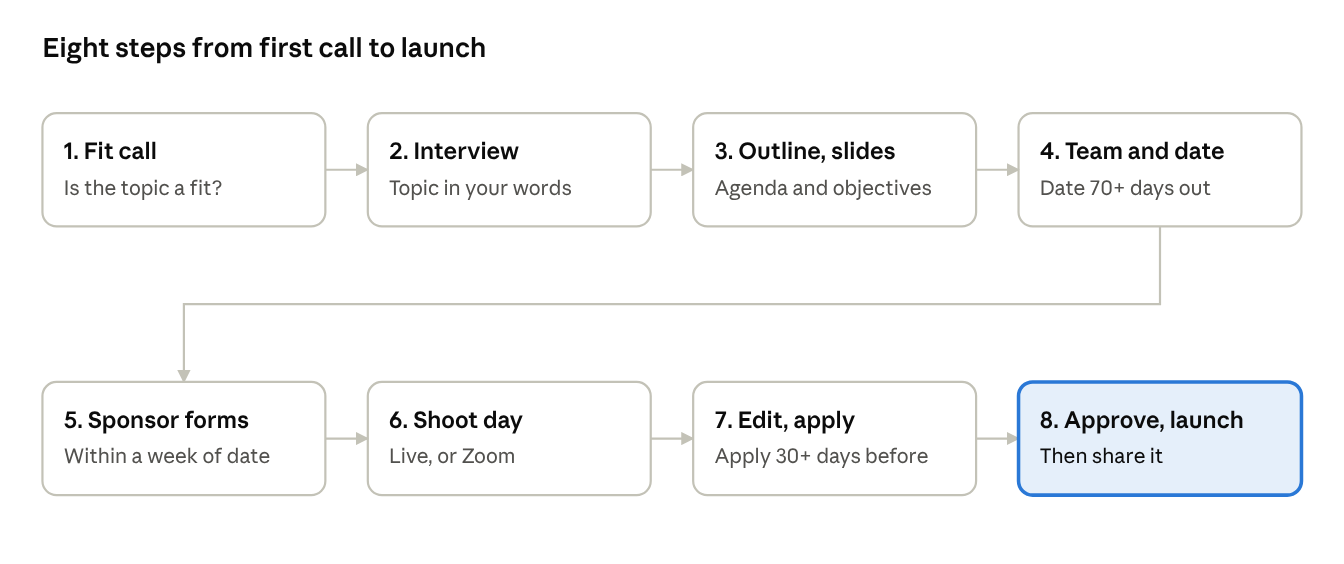
Fit call. Talk through the topic and who it's for. If it isn't a fit, better to know now.
Interview and questionnaire. Get the topic down in the speaker's own words, so the course gets it right.
Outline and slides. Chapters in the right order, learning objectives and a timed agenda.
Team and date. Speakers, a moderator, who covers what, and a date with your sponsor.
Sponsor forms. Every sponsor has its own. For the Business Law Section, that's a course development form (within a week of setting the date), a materials submission with slides, agenda and bios, and a headshots form. Each speaker signs a grant of license.
Shoot day. Live in front of an audience, or recorded on Zoom from your own office.
Edit and apply. Clean audio, slides matched to the conversation, and captions. The section's accreditation application goes in at least 30 days before the program.
Approve, then launch. Once The Florida Bar approves it, you share it.
For the speakers, the time goes into the fit call, the interview, a slide review and the recording itself.
Who's on the panel
A good panel gives each person one clear job: someone who knows the rules, someone who lives with them in practice, and a moderator who keeps it moving. For Navigating Lawyer Advertising Compliance: Foundations of Legal Advertising in 2024, I opened the session and moderated a panel that included Zach Hyman of Millennial Law and speakers from The Florida Bar.
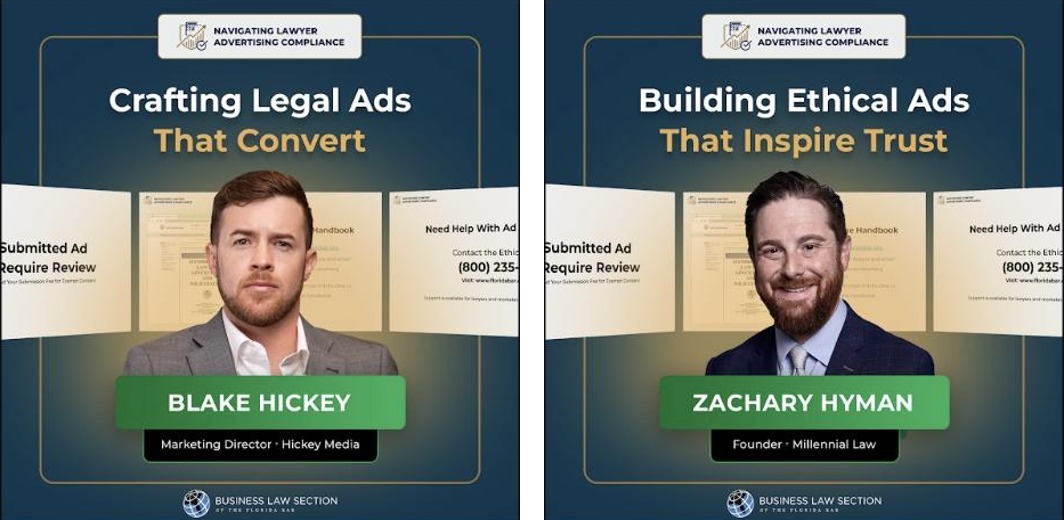
These are the speaker cards we made for that program, one per person. The section's headshots form asks every speaker for a photo and a bio, so gather them early.
How to teach it so people remember it
You're the lawyer, so I won't tell you how to teach your subject. But I've helped produce enough of these to see what keeps people watching:
Keep one idea per slide. If a slide needs a paragraph, that paragraph belongs in the handout.
Carry one example through the whole hour, like a made-up client the panel keeps coming back to.
Say it, show it and give a real example. Some people listen, some watch, and some only get it from the story.
Put the rule, opinion or case on the slide in small type so viewers can look it up later.
Have the moderator ask a question at every hand-off. A minute per answer is plenty.
Open with the not-legal-advice language, and close with a short list of what to do next.
Live or recorded? Both can earn credit. Live takes less editing, since what happens is what people see. Recorded takes more work afterward, but mistakes come out, music and graphics go in, and every slide lands at the right moment. Our 2024 program was recorded on Zoom, and you don't need a studio for one. A laptop, your notes and a quiet room will do.
What one recording turns into
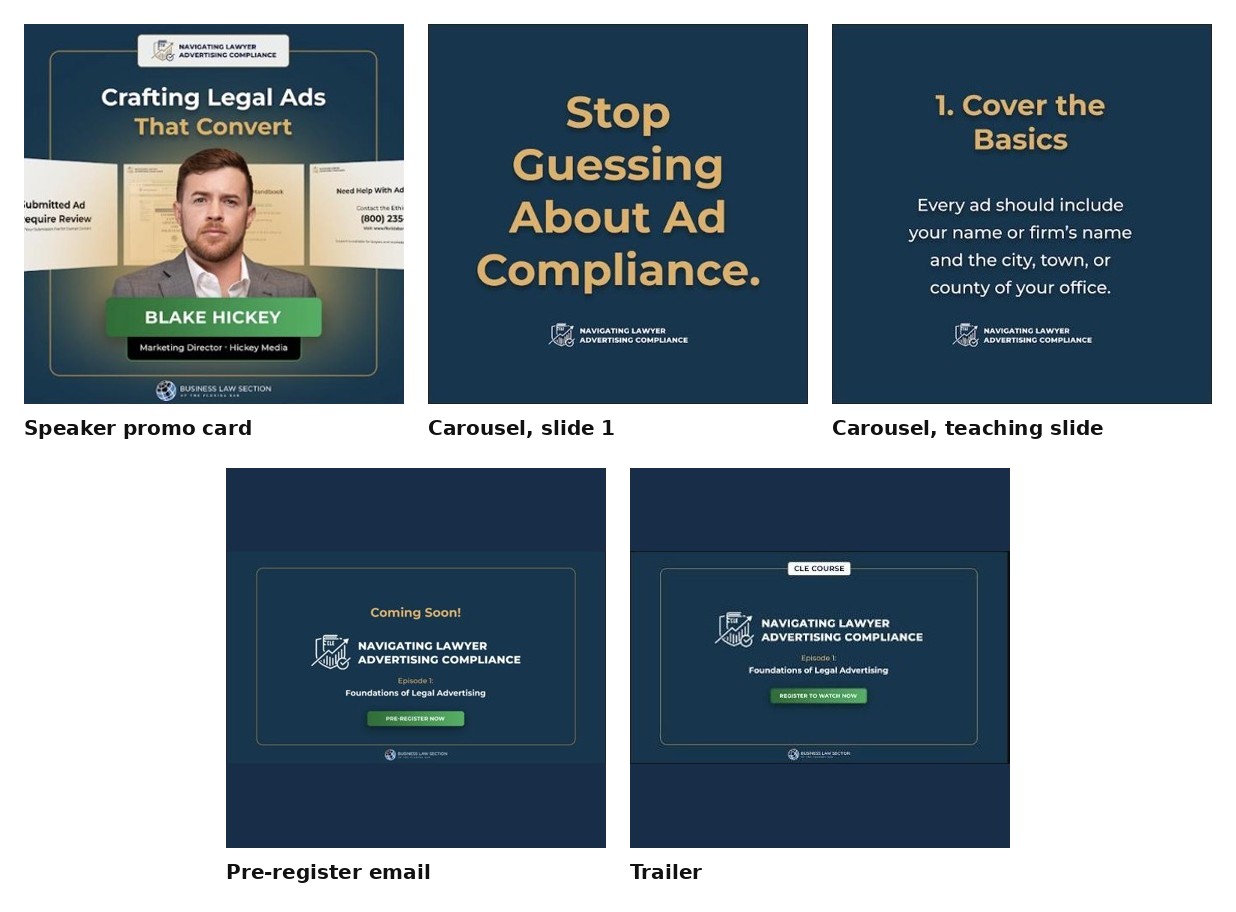
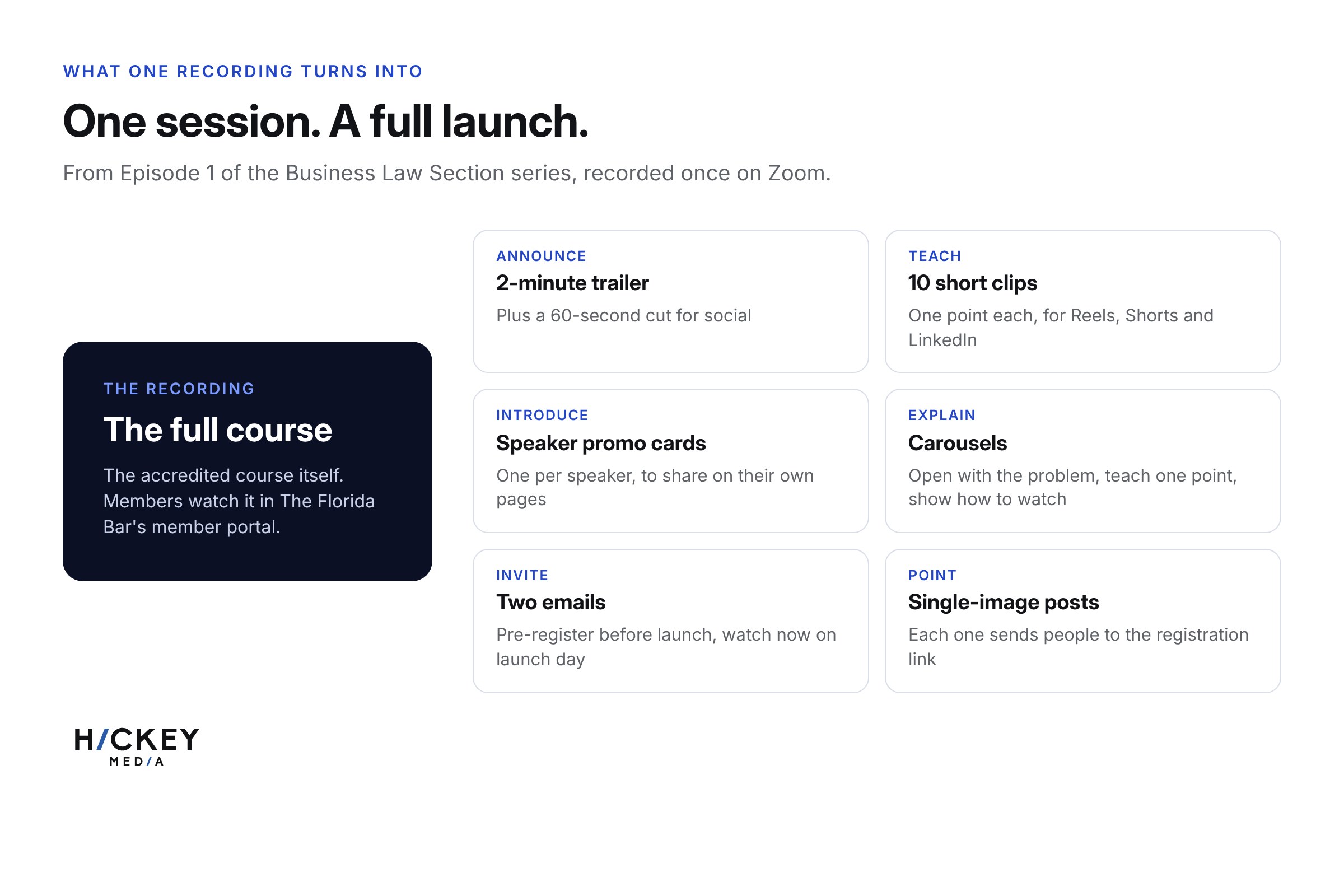
One recorded session became a full launch:
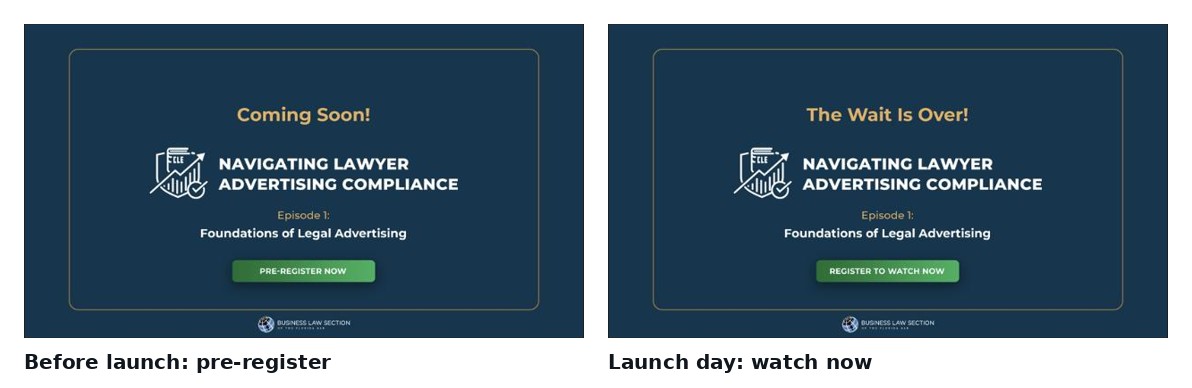
The emails went out in two waves, one before launch and one on launch day:
The order we rolled it out
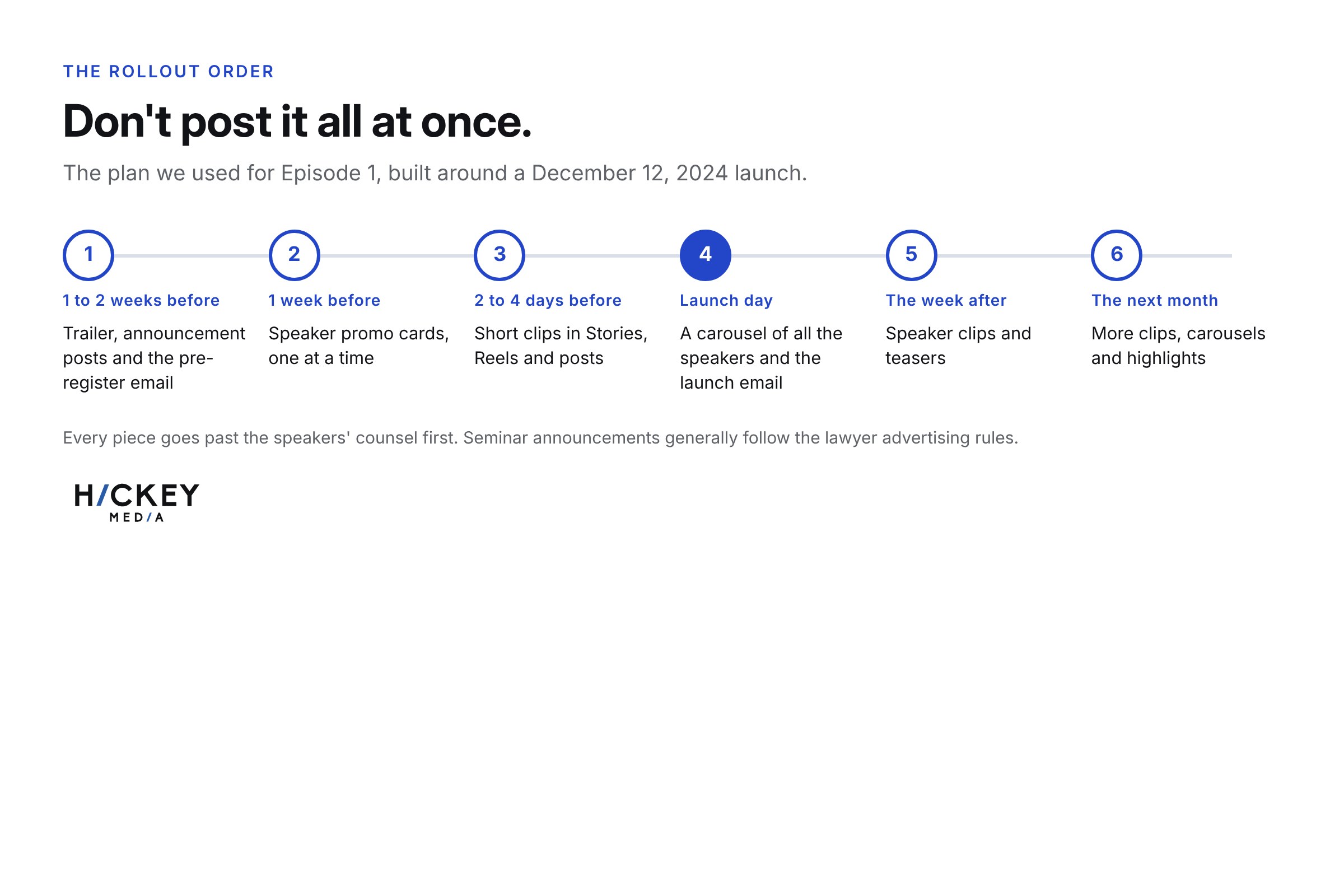
We didn't post everything at once. Here's the plan we used for the 2024 program:
What to post, and what to email
Keep posts short and plain. Ask the question your reader already has, say who answers it and what the course covers, and give one link. Here's an example you could post, and change for your own course:
Florida lawyers: do you know which of your ads have to be filed with The Florida Bar before they run?
In Navigating Lawyer Advertising Compliance: Foundations of Legal Advertising, presented by the Business Law Section, our panel walks through the basics of lawyer advertising and how to keep your marketing within the rules.
Approved for [X] hours of CLE credit. Watch it here: [link]
One note on that example: the program was recorded in 2024, and The Florida Bar's advertising rules and filing steps have changed since, including a new filing exemption for text-only search ads in Rule 4-7.20(i), adopted Oct. 22, 2026. For rule content, go to the current Chapter 4-7 and The Florida Bar's advertising pages, not an older recording.
Send two emails, and only to people the course fits, like the lawyers you know. One goes out before launch:
Subject: A CLE I'm working on
Hi [first name],
Quick heads-up: I'm teaching a CLE with the [section] on [topic]. It covers [the one problem it solves], and it should be out in [month]. I'll send the link when it's live. If you know someone who'd find it useful, I'd love for you to pass it along then.
[Your name]
And one on launch day:
Subject: It's live: [course title]
Hi [first name],
The CLE I mentioned is out. In about an hour, we cover [what it covers]. It's approved for [X] hours of CLE credit. Watch it here: [link]
If it's useful, feel free to share it with a colleague.
[Your name]
Fill in the brackets with your course's real details. The Florida Bar exempts communications mailed only to lawyers, clients and former clients from its ad filing requirement (Rule 4-7.20), while unsolicited direct email to anyone else generally has to be filed. Ask your counsel how that applies to your list before you send.
On your own website, post a short blog about the course with one image and a link. It gives search engines, and AI tools like ChatGPT, a page that says you taught it, and it's a page you can share.
What keeps all of this clean: it describes what the course covers, not results. It doesn't promise approval or outcomes, the credit line matches the approval exactly, and everyone named has said it's OK.
One caution before you post any of it: The Florida Bar's advertising handbook says seminar announcements generally have to follow the lawyer advertising rules. Run every piece past your counsel first.
Your CLE checklist
Copy this and work down it:
Pick a topic lawyers need, and the section or provider that fits it
Write 3 learning objectives
Build a timed agenda and topic outline
Confirm speakers, a moderator and who covers what
Reach out to the section and set a date (at least 70 days out for the Business Law Section)
Submit the section's forms, bios and headshots, and grants of license
Build slides and a handout, using your section's guidelines
Record, edit and add captions
Section files the accreditation application, at least 30 days before the program
After approval: trailer, clips, promo cards and emails, cleared with counsel
The Florida Bar resources you'll use
These are the pages I keep going back to, grouped by the question they answer.
Your question | Where to look |
|---|---|
How many hours do I need, and does teaching count? | |
What do the rules say? | Rules Regulating The Florida Bar (CLE is in Chapter 6) |
What does a course need to be approved? | |
What does the application ask for? | |
Can I become a CLE provider myself? | |
Which section fits my topic? | |
What has already been taught? | |
What does a section's planning look like? | |
Who answers credit questions? | |
What are the rules for promoting it? | Handbook on lawyer advertising and solicitation and Advertising regulation and information |
What's changing on AI? |
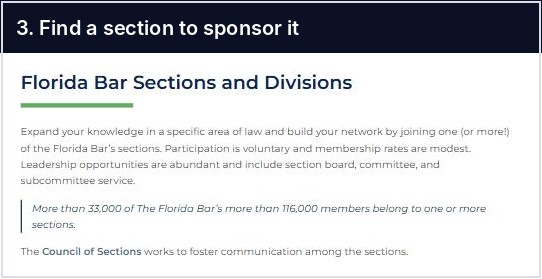
Here's what a few of those pages look like, so you know you're in the right place:
If you'd like a hand
The Florida Bar's CLE staff and your section are the people to ask about rules, credit hours and approval. They make those calls, and they're there to help.
I help with the parts around the course: shaping the outline and flow, moderating, recording and editing on Zoom, designing slides and promo cards, keeping forms and deadlines on track, and putting together the launch. You can do every bit of it yourself with this guide. If you'd rather hand off part of it, here are three ways to work together. My favorite is recording on Zoom, not live, so a mistake gets a retake, we edit it, everyone reviews the cut, and it goes in polished.
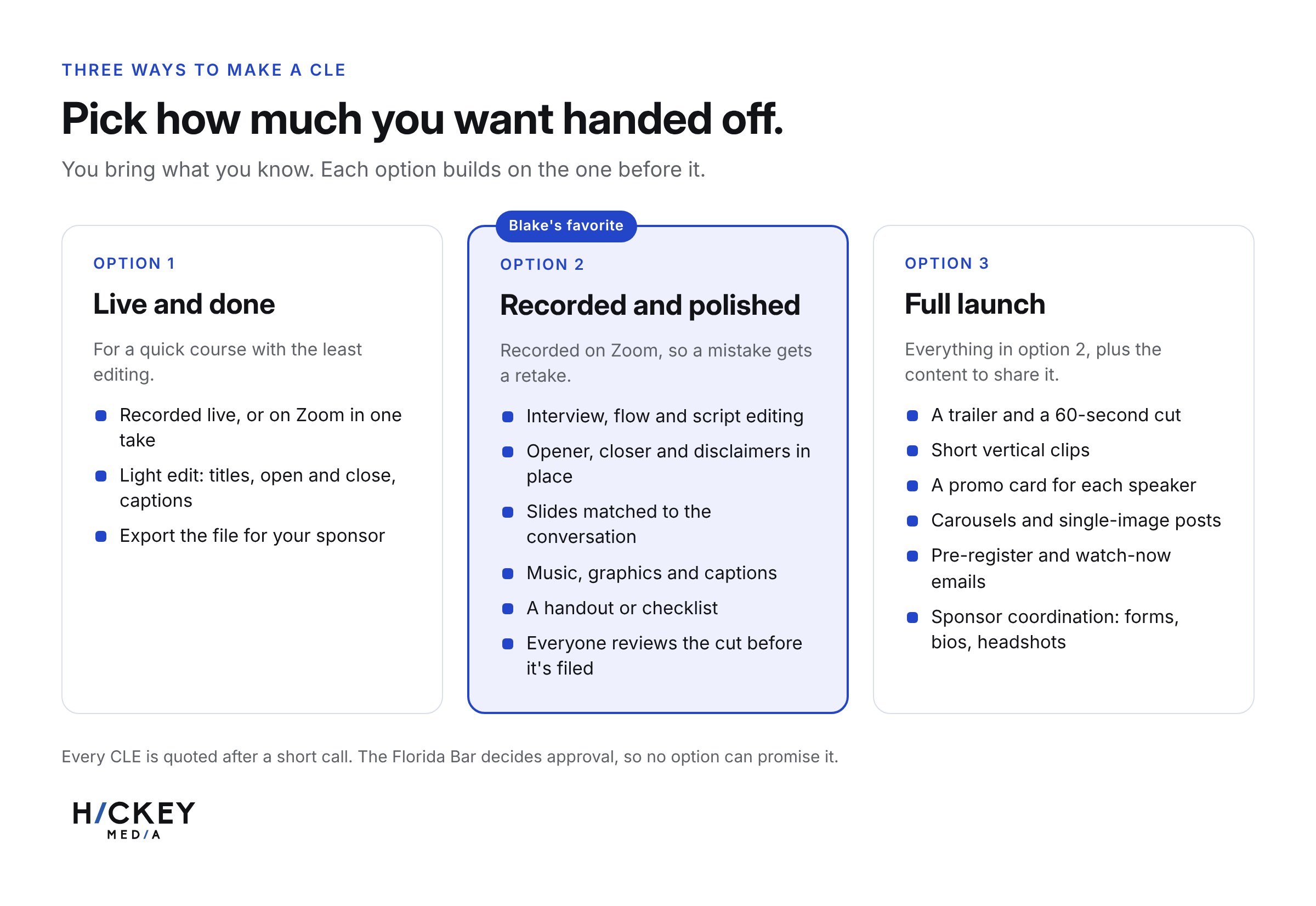
You review and approve every step. The Florida Bar decides approval, so nobody can promise it. Every CLE is different, so I quote it after a short call.
If you're the marketing person on a firm's team, this guide is meant for you, too. Use the checklist, and reach out if you get stuck.
FAQ
How long does a CLE course need to be? The Bar counts 50 minutes of course time as 1 credit hour, and 25 minutes as half an hour.
Do lawyers get credit for teaching one? The Florida Bar lists "lecturing at an approved CLE program" as a way to earn credit. Its CLE staff can tell you how many hours a given course earns.
Do I have to be a lawyer to present? The Bar's policy asks for speakers "qualified by practical or academic experience," so a non-lawyer can teach a part they know well. Each speaker needs a bio for the application.
Can a CLE be recorded instead of live? Yes. The Bar's policy gives recorded courses credit the same way it does live ones.
Who submits the course to The Florida Bar? The sponsor, such as a Bar section or another approved provider. Ask early how far ahead they need it.
Can I use the CLE to promote my firm? The course itself has to teach, not sell. Promotion afterward can work, but it follows the lawyer advertising rules, so run it past your counsel.
General information, not legal advice. Blake is not a lawyer. For your situation, talk to your own lawyer, and Bar members can call The Florida Bar Ethics Hotline at 800-235-8619. Hickey Media is not affiliated with or endorsed by The Florida Bar.